Surrey, Green Belt
Green Belt planning in Surrey.
Much of Surrey lies within the Metropolitan Green Belt, but that rarely means nothing can be built. It means the case has to be made properly. We know where the limits sit, and where there is room to argue.
The reality
Green Belt is restrictive, not absolute.
Most of Surrey outside its towns falls within the Metropolitan Green Belt, where policy protects openness and resists new building. But Green Belt policy has always allowed for certain development: the replacement of existing dwellings, limited infilling, the reuse of previously developed land, and proposals that can demonstrate very special circumstances. The skill is in knowing which route a site can genuinely support.
With a chartered architect and a chartered planner under one roof, we test the opportunity, design to it, and build the planning case together, rather than designing a scheme and hoping it passes.
Where the value is
Replacement dwellings, and the fallback that unlocks them.
The most common opportunity is the replacement dwelling. Surrey's authorities apply their own limits on how much larger a new house can be than the one it replaces, usually measured by volume or floor area. But the size you are allowed is not always fixed by the existing house alone: where there is development that could lawfully be carried out anyway, that fallback position can justify a materially larger home. Building that argument, with evidence, is often what unlocks the house our clients actually want.
Local knowledge
The Surrey authorities.
We work across the Surrey Green Belt authorities, including Waverley, Guildford, Woking, Mole Valley and Surrey Heath. Each interprets replacement-dwelling and openness policy slightly differently, and knowing those differences shapes how a scheme is designed and presented.
The new rules
Grey belt, and what the new NPPF changed.
The 2024 to 2026 reforms to the National Planning Policy Framework introduced a new category called "grey belt": land within the Green Belt that is either previously developed, or does not strongly serve three of the Green Belt's purposes, namely checking sprawl, keeping neighbouring towns apart, and preserving the setting of historic towns. Under the August 2026 framework those purposes sit at Policy GB2, and grey belt is defined against them.
On land that qualifies, development can be treated as not inappropriate where it would not fundamentally undermine the remaining Green Belt, answers an evidenced unmet need, and sits in a sustainable location (Policy GB7). Where the proposal is major housing, it must also meet the Golden Rules (Policy GB8): a higher affordable-housing contribution, real improvements to local infrastructure, and new accessible green space. Being grey belt does not, by itself, make a site developable. It is one consideration among many, and the case still has to be argued.
This matters in Surrey because housing targets have risen sharply. Guildford's own Green Belt Assessment, published in July 2026, maps grey belt across the borough as its assessed need rose from 562 to 1,168 homes a year, and the other authorities are working through the same exercise. Knowing where a site sits in that evolving evidence base is now part of reading the opportunity.
The work
Proven in the Surrey Green Belt.
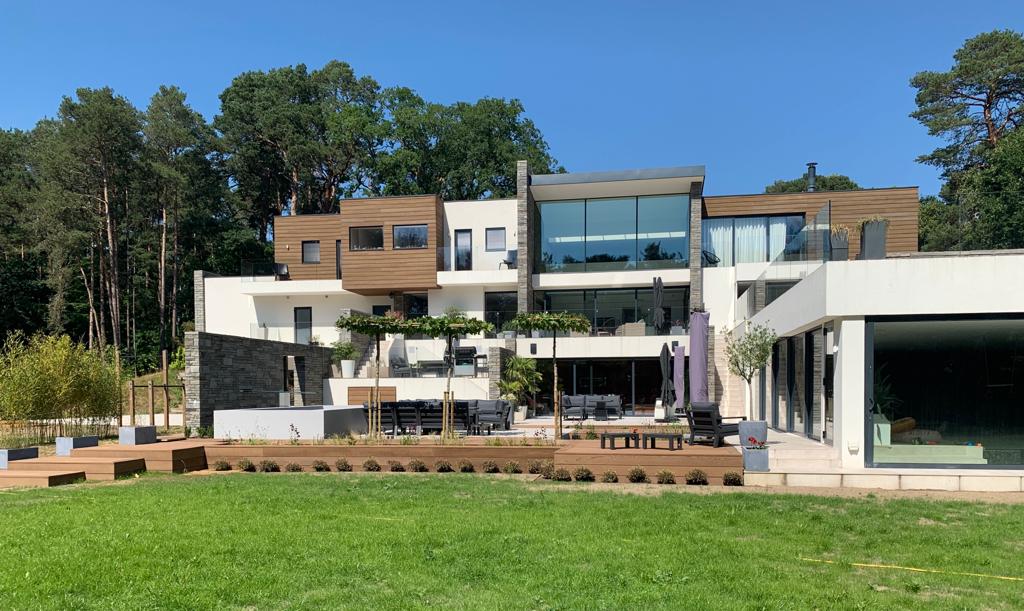
Our contemporary house at Seale, in the Surrey Green Belt near Farnham, secured a substantial uplift in floor space through a carefully built fallback position, won at appeal, and has since become a local landmark and a film location.
Get in touch
Send us your site address.
Tell us where the site is and a little about what you have in mind. We'll come back with a clear, realistic view of the options.